CBRS vs MOCN vs MORAN: understanding indoor cellular architecture for enterprise IT
If you're researching indoor cellular coverage for your building, you've probably run into a wall of acronyms: CBRS, MORAN, MOCN, licensed spectrum. These terms get used frequently in vendor conversations, but they describe fundamentally different approaches to solving the same problem: getting reliable cell signal inside your building.
We'll cover:
- What CBRS is and why it was a popular starting point for indoor cellular
- What licensed spectrum means and why it matters
- The difference between MORAN and MOCN
- When each architecture makes sense for enterprise deployments
What is CBRS?
Citizens Broadband Radio Service (CBRS) is a shared radio spectrum band in the 3.5 GHz range that the FCC opened for commercial use in the United States in 2020. Unlike traditional carrier spectrum, CBRS doesn't require a license agreement with any of the three major US cell carriers. Any qualified organization can apply to use it through a spectrum access system (SAS) that coordinates usage to prevent interference.
CBRS made indoor private cellular accessible to organizations that couldn't justify the cost and complexity of traditional licensed spectrum —no carrier contracts, no spectrum auctions, no lengthy coordination agreements. That lower barrier to entry is why neutral host deployments became practical for buildings and venues in a way they simply weren't before.
There are limitations to consider. CBRS operates in shared spectrum, which means performance can be inconsistent depending on what else is competing for that band in your area. It tops out at lower throughput than licensed spectrum. And most importantly, carriers treat CBRS as a separate network, so it doesn't extend their core infrastructure indoors the way licensed spectrum does. That separation has a key consequence: handovers between a carrier's outdoor cell towers and an indoor CBRS deployment aren't seamless. Users moving between the two may experience dropped connections or degraded performance during the transition, a friction point that architectures like MORAN, which operate on the carrier's own licensed spectrum, don't have.
What is licensed spectrum?
Licensed spectrum refers to specific radio frequency bands that carriers (AT&T, Verizon, & T-Mobile) have purchased and hold exclusive rights to use within defined geographic areas. When you use your phone outdoors, you're connecting to towers broadcasting over that carrier's licensed frequencies. Nobody else can broadcast on those bands in that area without the carrier's authorization.
Licensed spectrum delivers the consistency and capacity that shared spectrum like CBRS can't always guarantee. Because carriers own these bands outright, they can engineer their networks to specific performance standards, support higher throughput, and prioritize traffic in predictable ways.
For indoor cellular, licensed spectrum means one thing above all else: when a carrier extends coverage indoors over its own licensed bands, users get the same experience they'd get outside. Same network, same signal quality, same priority handling. That consistency is what makes licensed spectrum the baseline requirement for enterprise deployments where reliable multi-carrier coverage isn't optional.
Common licensed bands used for indoor cellular deployments include AWS (2100 MHz) and PCS (1900 MHz) — the same frequencies carriers use on their macro towers.
MORAN vs MOCN: what's the difference?
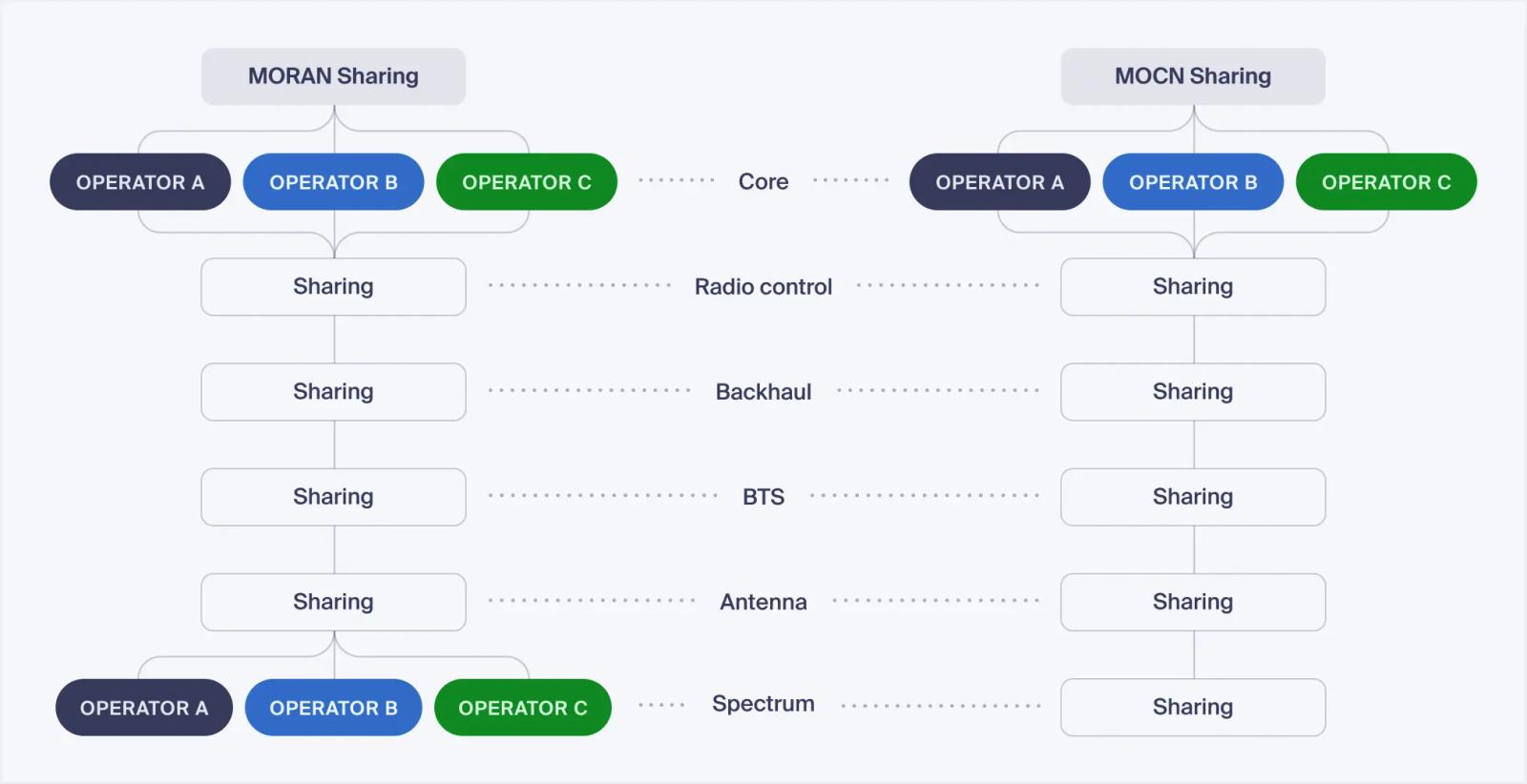
Both MORAN (Multi-Operator Radio Access Network) and MOCN (Multi-Operator Core Network) are neutral host architectures, meaning they let a single set of indoor radio infrastructure serve multiple carriers at once. The difference is where in the network the carrier separation happens.
In a MORAN deployment, each carrier uses its own dedicated licensed spectrum over shared physical radio hardware. The radios, access points, and fronthaul infrastructure are shared, but each carrier's signal travels on its own frequencies. The carriers' core networks remain completely separate from one another. This is the architecture that aligns most naturally with how carriers think about their networks — they're simply extending their licensed spectrum into the building using your infrastructure rather than building their own.
MOCN goes one step further. In a MOCN architecture, carriers actually share the same radio spectrum, not just the same hardware. Multiple operators broadcast on the same frequencies simultaneously, with the network differentiating traffic at the core level. This requires deeper integration with carrier core networks and more complex coordination agreements. For most enterprise deployments, this level of complexity exceeds what's operationally practical.
The practical distinction for an IT or network admin comes down to this: MORAN is the carrier-preferred, operationally straightforward path for multi-carrier indoor coverage, while MOCN introduces spectrum sharing that most carriers aren't set up to support at the enterprise level today.
Which architecture should enterprises be looking at?
For most enterprise buildings — offices, hospitals, campuses, warehouses — MORAN on licensed spectrum is the right architecture. Here's why.
Carrier alignment is the biggest factor. MORAN works with how carriers already operate: each carrier keeps control over their own licensed frequencies, which means they're willing partners rather than reluctant participants. Deployments can cover all three major US cell carriers simultaneously, along with their respective MVNOs (Cricket, Xfinity Mobile, and others). Users don't need to change anything about their phone or plan — they just walk in and connect.
Performance is the second major factor. Licensed spectrum on MORAN delivers the same throughput users get outdoors, and supports the full 5G feature set — capacity headroom, lower latency, and the density handling that environments like hospitals or office buildings require. Neutral host CBRS, by contrast, is LTE-only today with no clear roadmap to 5G. For organizations planning infrastructure that needs to scale with 5G over the next several years, that's a meaningful gap.
CBRS still has valid use cases: single-carrier deployments, private cellular for IoT environments, and outdoor coverage in specific scenarios. But for multi-carrier enterprise indoor coverage, MORAN on licensed spectrum is where the architecture is headed.
How Meter Cellular approaches this
Meter Cellular is built on a MORAN architecture over licensed spectrum, with active agreements in place with all three major cell carriers in the United States. Meter functions as a neutral third party - extending the three carriers’ licensed frequencies indoors through a single managed deployment.
The physical installation runs on standard CAT6 ethernet cabling rather than the thick coaxial cabling traditional distributed antenna system (DAS) deployments require. There's no upfront capital cost — Meter Cellular is priced as a monthly subscription per square foot, the same model as the rest of the Meter stack. Installation runs up to 3x faster than traditional DAS, which typically requires 12 or more months from contract to live coverage.
Meter handles the full deployment: site survey and cellular design, low-voltage cabling, access point installation, E911 compliance verification, and ongoing performance monitoring. All major carrier MVNO traffic is supported, and the system respects carrier priority programs for first responders.
Meter Network is required alongside Meter Cellular MORAN, providing internet connectivity to the baseband units and power monitoring in each intermediate distribution frame. If you're already on Meter's network infrastructure, Cellular is a natural addition to your existing stack.
For IT and network admins evaluating indoor cellular options, the architecture choice matters — and licensed spectrum MORAN is the path that carriers support, enterprises can operate, and users won't notice because everything just works.
Schedule a demo at meter.com/demo