The IT team's guide to DAS alternatives for indoor cellular coverage
Poor indoor cell service is one of those problems that never fully disappears from your ticket queue. Employees drop calls in conference rooms, visitors can't connect, and the fix everyone suggests—a distributed antenna system (DAS)—comes with a price tag and timeline that can stop a project cold before it starts. There's a better path. This guide breaks down your real options so you can make the case internally and move faster.
We'll cover:
- Why traditional DAS is so painful to deploy
- How passive DAS and signal boosters compare
- What MORAN-based neutral host technology actually is
- How Meter Cellular stacks up against every alternative
- What to consider when choosing the right solution for your space
- Common questions IT teams ask before deciding
Why is indoor cellular coverage still such a problem?
Buildings attenuate radio signals. Glass, concrete, steel—all of it works against your carriers' outdoor macro network. The result is that your employees may have full bars on the sidewalk and zero service at their desks. This isn't a carrier problem; it's a physics problem. Solving it requires bringing signal generation inside the building, and that's where your options diverge sharply.
What is active DAS?
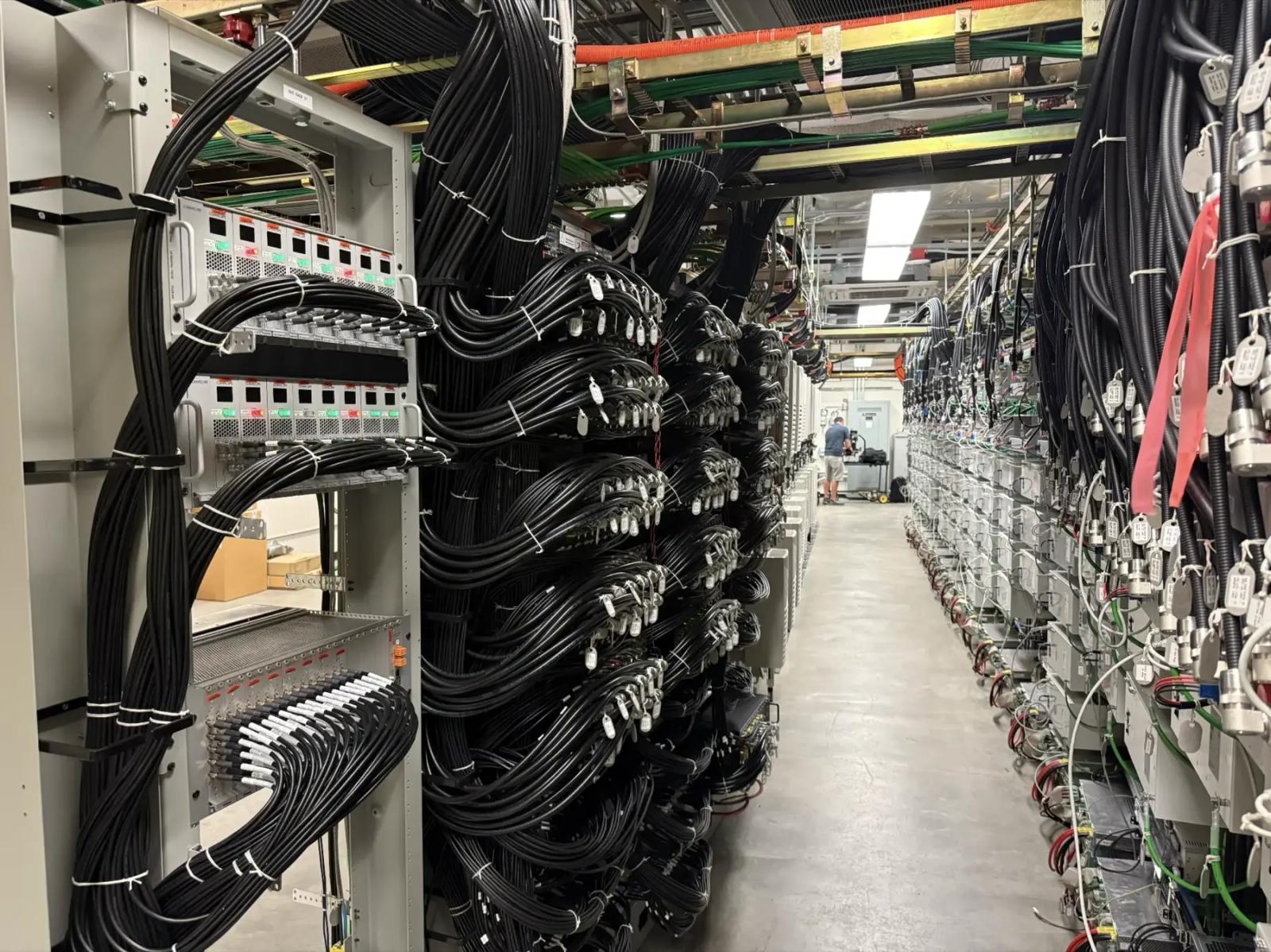
Active distributed antenna system (DAS) is the traditional enterprise-grade answer to indoor cellular coverage. A headend unit connects to dedicated fiber runs from each carrier, converts the signal to optical or digital, distributes it through coaxial cabling to remote antenna units throughout the building, and rebroadcasts it indoors.
Active DAS is the gold standard for raw capacity in very large venues. Sports arenas, airports, and major hospital campuses have relied on it for good reason.
The problems start when you look at the logistics. The cost for a 500,000 sq ft deployment runs $1,900,000 or more, and that's before ongoing maintenance fees. Timelines regularly stretch beyond 12 months from contract to go-live because each carrier (AT&T, Verizon, T-Mobile) must independently negotiate, engineer, and activate their feed. The coordination burden sits largely on you or your integrator. You'll also need a dedicated equipment room, often climate-controlled, and new coaxial cabling pulled throughout the building. For a new construction project with long lead times, that can be manageable. For an existing space where your employees have been complaining for two years, it's a non-starter.
What about passive DAS and signal boosters?
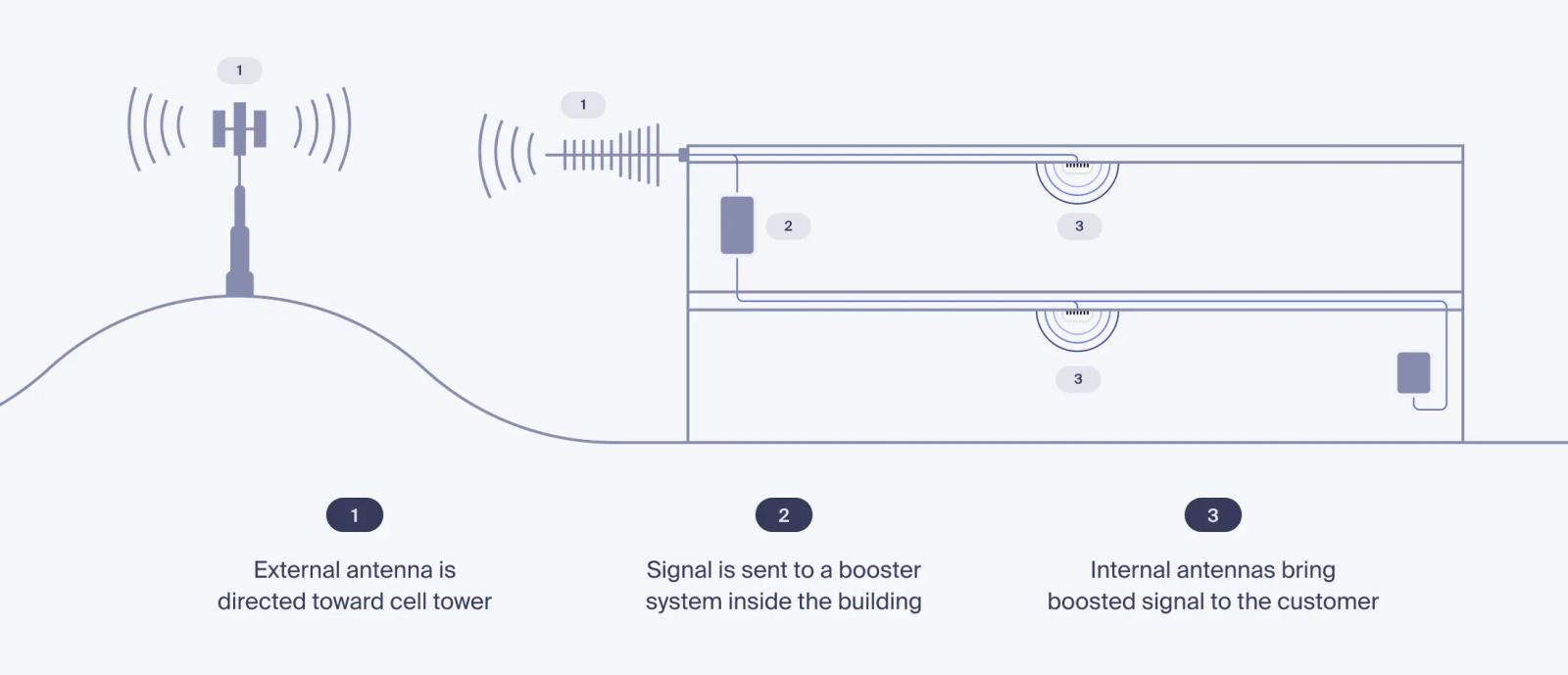
Passive DAS takes a simpler approach: it captures an existing outdoor signal via a donor antenna on the roof, amplifies it, and redistributes it through coaxial cabling. There's no headend equipment room, and timelines run one to four months. Costs are dramatically lower than active DAS—starting around $50,000 for a 50,000 sq ft space—and installation is somewhat less complex.
The core limitation is right in the name. A passive system can only amplify what's already there. If your building is in a weak coverage area, or if outdoor signal degrades over time, your indoor coverage degrades with it. Capacity is also bounded by the local macro tower. In high-density environments—a busy open office floor, a packed conference center—passive DAS can become a bottleneck quickly. It also typically requires roof access and carrier coordination, which isn't always straightforward depending on your lease situation and building management.
Signal boosters are essentially a consumer-grade version of passive DAS. They're fine for a small office with mild signal problems, but they're not a real enterprise answer. Capacity is limited, they can interfere with carrier networks if not properly certified, and they don't support multi-carrier environments reliably.
What is neutral host MORAN, and why does it change the equation?
MORAN stands for Multi Operator Radio Access Network (pronounced "Moe-RAN"). Instead of amplifying an outdoor signal or requiring dedicated fiber from each carrier, a MORAN system extends the carriers' own licensed spectrum directly into your building over internet backhaul. The cellular access points connect to the Meter network stack over standard CAT6 ethernet cabling—the same wiring already in your walls—and bring the signal in from there.
The neutral host architecture means a single piece of hardware simultaneously broadcasts for AT&T, Verizon, T-Mobile, and their MVNOs. Every employee, regardless of carrier, connects seamlessly. No app to install, no carrier profiles to push, no captive portal to dismiss. Their phone sees the same signal quality they'd expect walking past a cell tower outside—just extended indoors.
Licensed spectrum carries meaningful performance advantages over older approaches like CBRS (Citizens Broadband Radio Service). There are no shared-use limitations, throughput is higher, and 5G features are fully supported. Individual clients on a MORAN access point can expect 300–400 Mbps each—a substantial jump over prior-generation indoor cellular hardware.
Coverage planning is straightforward: each Cellular Access Point covers roughly 6,000 sq ft in dense office environments and up to 12,000–15,000 sq ft in open warehouse or floor-plate designs. As a rule of thumb, for every three to four Wi-Fi access points in a space, you need one Cellular Access Point.
How does Meter Cellular compare to the alternatives?
Here's the practical breakdown for IT decision-makers:
| Meter Cellular | Active DAS | Passive DAS | |
|---|---|---|---|
| Cabling | CAT6 ethernet | Coaxial + cooled equipment room | Coaxial + roof access |
| Deployment timeline | Weeks | 12+ months | 1–4 months |
| Carrier coordination | Handled by Meter | Complex, multi-carrier | Somewhat complex |
| Carriers supported | AT&T, Verizon, T-Mobile + MVNOs | Depends on agreements | Signal-dependent |
| Capacity | Medium/high | High | Dependent on local tower |
| Price (500k sq ft) | Affordable monthly per sq ft | $1,250,000+ upfront | N/A at that scale |
| Upfront cost | None | High | Moderate |
| Pricing model | Monthly OpEx | CapEx + maintenance | CapEx + maintenance |
| Minimum space | ~40,000 sq ft | Large venues | Small to mid |
| E911 compliant | Yes | Yes | Varies |
| HIPAA/PCI compatible | Yes | Yes | Varies |
The cost comparison is stark. Active DAS requires a capital expenditure that most enterprise IT budgets don't have sitting around—and the ROI math is hard to build when the timeline to live service is over a year. Meter Cellular flips the model entirely: no upfront hardware cost, no equipment to own or depreciate, and pricing per square foot on a monthly basis that scales with your footprint.
What should you think about before choosing a solution?
Space and size: Meter Cellular is purpose-built for enterprise deployments of 40,000 sq ft or larger. Below that threshold, the per-square-foot economics don't work as well. For a single small office with weak signal, a certified signal booster or passive DAS may be the more pragmatic choice. For anything at enterprise scale—a corporate headquarters, a multi-floor office campus, a warehouse, a retail chain—MORAN is the right conversation.
Your existing infrastructure is an asset: If you already have CAT6 runs and a Meter Network deployment, adding Cellular is straightforward. The access points plug into your existing network stack. Meter handles the design, installation, E911 verification, carrier activation, and ongoing monitoring. You don't manage carrier relationships or coordinate separately with each provider.
Compliance is already handled: Cellular traffic stays encrypted within the carriers' licensed spectrum and core network—Meter only manages the infrastructure layer. That means HIPAA and PCI environments don't inherit a new compliance scope. Every installation includes E911 (Enhanced 911) verification, ensuring emergency calls route accurately based on the caller's location.
Security is not a new variable: Because traffic travels over the carriers' own licensed spectrum end-to-end, it behaves exactly as it would outdoors. Meter doesn't touch the carrier traffic—only the infrastructure that delivers it indoors.
Emergency responder radio channels are separate: One common question: can Meter Cellular extend two-way radio coverage for fire, EMS, or police indoors? No—that falls under a separate passive DAS solution tied to fire annunciator panels and monitored battery backup. It's a different product category and a different compliance domain. Meter Cellular handles cellular voice and data for every major carrier; it doesn't replace a building's public safety communications system.
Why IT teams are moving to Meter Cellular
Reddit deployed Meter Cellular at their Santa Monica office after experiencing persistent connectivity issues with cellular devices. Their team noted that Meter provided the quickest and most convenient solution available while also being cost-effective—directly integrated with their existing Meter stack.
MrBeast deployed both Meter Network and Cellular across their production campus. Staff on AT&T and T-Mobile immediately noticed reception bars on their phones after installation—without any added vendor complexity or additional management overhead.
Both deployments went live in weeks, not months. That timeline is not an anomaly—it reflects the structural advantage of running on CAT6 ethernet over an internet backhaul instead of requiring dedicated carrier fiber and new coaxial infrastructure.
Frequently asked questions
Does Meter Cellular work if we already have a DAS system?
Yes. Meter Cellular can augment an existing DAS installation that isn't performing well, or replace it entirely. Either path is on the table.
Do all carriers go live at the same time?
Typically, Meter brings carriers online in phases. One carrier may activate first, with others following within weeks as agreements finalize. Meter manages that coordination so you don't have to.
Does this work with first responder programs like FirstNet?
Yes. Meter Cellular supports FirstNet, T-Priority, and Verizon Frontline—the carriers' priority service programs for first responders. The system respects the priority designation assigned to those devices, so first responders get higher priority on the Meter Cellular network just as they would on the macro network outdoors.
What does the pricing model look like? Meter Cellular is priced on a monthly per-square-foot basis—no upfront capital expenditure required. It's the same OpEx model as Meter Network, and if you're already a Meter Network customer, Cellular can be added to your existing deployment.
Is Meter Network required to run Meter Cellular?
Yes. Meter Network sits in front of the Cellular hardware and provides internet access to the system. For customers running both products, it's a seamlessly integrated stack. Customers deploying Cellular without an existing Meter Network will have a dedicated Meter network deployed alongside it to support the Cellular infrastructure.
Can Meter Cellular scale across multiple locations?
Absolutely. Whether you need coverage for a single headquarters, a multi-building campus, or hundreds of retail locations, the architecture scales. Coverage can be extended by adding Cellular Access Points, and Meter manages design and deployment at each site.
Meter Cellular
Meter Cellular is the cellular layer of Meter's full enterprise networking stack—the same unified platform that handles your ISP procurement, routing, switching, Wi-Fi, security, DNS, and VPN. Adding Cellular means one deployment, one bill, and one team responsible for the entire environment.
Meter handles design, installation, carrier activation, E911 verification, 24/7 monitoring, and proactive maintenance. Hardware upgrades are included. There's no capital expenditure, no equipment to manage, and no separate vendor to coordinate with.
With agreements in place with AT&T, Verizon, and T-Mobile, Meter Cellular supports every major carrier and their MVNOs—so every employee, on every carrier, gets full bars when they walk through your door.
If your building has a cellular coverage problem and your options have felt like "spend a million dollars and wait a year" or "live with it," there's a third path.
Schedule a demo at meter.com/demo